
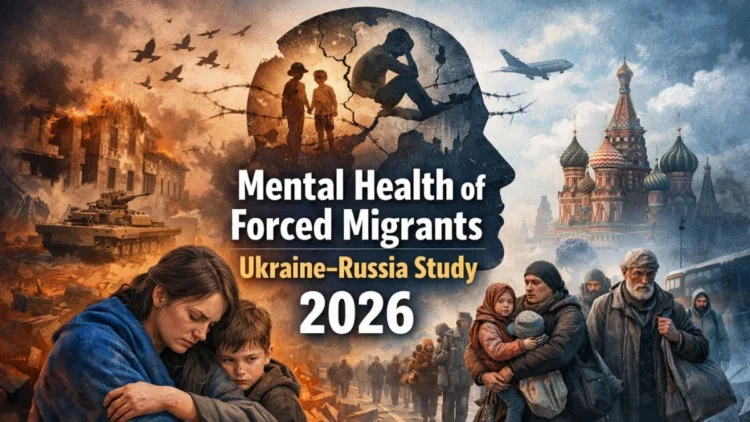
A recent study published in Scientific Reports explores how pre-migration and post-migration stressors influence mental health among forced migrants from Ukraine and Russia. The research aims to identify key risk factors, compare mental health outcomes between both groups, and evaluate coping strategies used during displacement.
The study was conducted using a cross-sectional online survey (CAWI method) with 200 Ukrainian and 164 Russian participants, collected in early 2025 during the third year of the ongoing war.
Higher Mental Health Burden Among Ukrainian Migrants
Findings reveal that Ukrainian migrants experience significantly higher levels of psychological distress compared to Russian migrants.
- Anxiety: 45% (Ukrainians) vs 37% (Russians)
- Depression: 56% vs 39%
- Stress Levels: 20.76 vs 18.79
These results highlight the severe emotional impact of displacement and conflict exposure on Ukrainian refugees.
Differences in Coping Strategies
The study also identifies distinct coping behaviours between the two groups. Ukrainian female migrants were more likely to adopt emotion-focused and resignation-based coping mechanisms, while Russian migrants tended to rely on problem-solving approaches.
Such differences play a crucial role in shaping mental health outcomes and resilience during migration.
Key Risk Factors Affecting Mental Health
Several predictors were linked to poorer mental health outcomes:
Among Ukrainian Migrants
- Negative attitudes from host communities
- Frequent relocation after arrival
- Higher levels of education
- Use of emotional or avoidance coping strategies
Among Russian Migrants
- Lower perceived quality of life
- Underemployment or unstable work
- Host community discrimination
- Emotion-focused or avoidance coping
These findings suggest that post-migration challenges and ineffective coping mechanisms are major contributors to mental health issues.
Research Approach and Limitations
Mental health conditions were measured using standardized tools such as PHQ-9 (depression), GAD-7 (anxiety), and PSS-10 (stress). Statistical analysis, including multivariate regression, was used to determine key predictors.
However, as the study is cross-sectional, the results show associations rather than direct cause-and-effect relationships.
Conclusion
This study highlights the significant psychological challenges faced by forced migrants, particularly those from Ukraine. It underscores the importance of addressing post-migration stressors, improving social support systems, and promoting effective coping strategies. Strengthening these areas could play a critical role in improving mental health outcomes for displaced populations worldwide.